 Fishen
Fishen
Fishen
CNC machining centers revolutionize manufacturing for businesses. These advanced tools combine precision with automation. The benefits of using a CNC machining center are numerous and impactful.
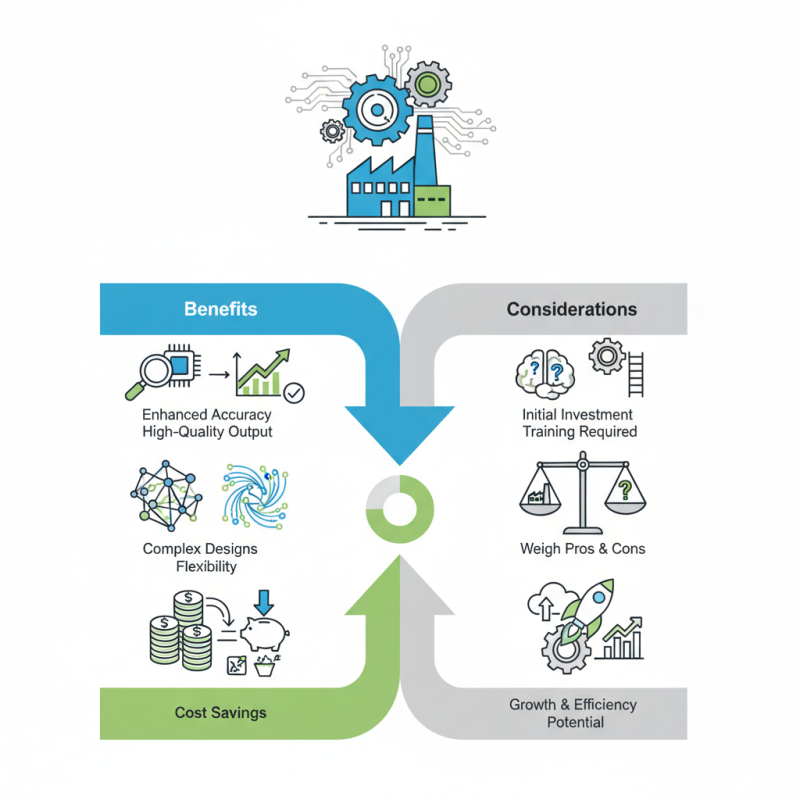
One key advantage is enhanced accuracy. CNC machines produce parts with minimal error. This ensures high-quality output, reducing waste during production. Moreover, businesses can achieve complex designs that might be impossible with traditional methods. The flexibility of CNC machining allows companies to adapt to changing demands quickly and efficiently.
Additionally, employing a CNC machining center can lead to significant cost savings over time. Despite a higher initial investment, these machines reduce labor costs. They also minimize material waste. However, not all businesses may be ready to transition. The training required can be a hurdle. Companies must weigh the pros and cons carefully before making the leap to automation. Ultimately, the decision to utilize a CNC machining center can define a business's potential for growth and efficiency.
CNC machining has become a cornerstone of modern manufacturing processes. This technology offers precision and efficiency that traditional methods often lack. With computer-controlled tools, businesses can produce complex designs with minimal waste. The capability to automate these processes reduces human error and enhances product quality.
One significant advantage of CNC machining is its scalability. Whether producing a small number of parts or large-scale runs, CNC machines can adjust quickly to changing demands. This flexibility is particularly vital in industries where rapid prototyping is essential. However, not all businesses fully utilize this potential. Some struggle to train staff effectively, which can limit productivity.
Another benefit is the ability to work with various materials. CNC machines can handle metals, plastics, and composites alike, streamlining the manufacturing process. Yet, there's a common oversight in underestimating machine maintenance. Neglecting this aspect can lead to downtime, impacting production timelines. Managers should weigh the advantages against the challenges to optimize their CNC operations.
| Benefit | Description | Impact |
|---|---|---|
| Precision | CNC machining centers provide high levels of precision in manufacturing parts, reducing errors and rework. | Improved product quality |
| Efficiency | Automated processes allow for faster production rates compared to manual machining. | Reduced lead times |
| Flexibility | CNC machining centers can be easily programmed for various designs, allowing for diverse production runs. | Adaptable manufacturing |
| Reduced Material Waste | CNC machines optimize the material usage which significantly lowers waste. | Cost savings |
| Labor Cost Savings | Automation reduces the need for skilled labor, decreasing overall labor costs. | Increased profitability |
| Complex Geometry | CNC technology can produce intricate shapes that are difficult to achieve through traditional methods. | Expanded product capabilities |
| Consistency | CNC machines deliver consistent products with uniformity across all parts produced. | Improved reliability |
| Scalability | CNC machining allows businesses to easily increase production volume as needed. | Meeting demand fluctuations |
| Integration with CAD/CAM | CNC machines can be easily integrated with CAD/CAM software for enhanced design and production processes. | Streamlined workflow |
| Improved Safety | CNC machines operate with minimal human intervention, lowering the risk of workplace accidents. | Safer working environment |
: CNC machining uses computer-controlled tools for precise manufacturing. It improves efficiency compared to traditional methods.
Automation in CNC machining can boost production speed by 30%. It allows tighter deadlines and smooth workflow.
CNC machines handle metals, plastics, and composites. This versatility streamlines various manufacturing processes.
Training staff effectively is crucial. Neglecting maintenance can lead to downtimes and operational inefficiencies.
Regular machine maintenance and better cutting strategies can minimize waste. This leads to lower material costs.
Yes, the initial investment can be high. However, benefits like reduced labor costs may offset this over time.
Skilled operators are essential to manage automated systems effectively. Ignoring this can lead to operational challenges.
Advanced software aids in planning and simulation. Identifying errors early can save time and resources.
They may miss opportunities for cost savings. Regular analysis can reveal inefficiencies in current operations.
Continuous assessment is needed to adapt and optimize processes. Embracing change is vital for long-term success.
The use of CNC Machining Centers in modern manufacturing processes offers numerous advantages that can significantly benefit businesses. These advanced machines provide enhanced precision and accuracy, enabling manufacturers to produce intricate components with minimal errors. Additionally, the automation and speed of CNC machining streamline production, leading to increased efficiency and faster turnaround times.
Moreover, CNC Machining Centers contribute to cost reduction and waste minimization, allowing businesses to optimize their resources effectively. The flexibility and versatility of this technology make it suitable for various industries, adapting to different materials and complex designs with ease. Overall, integrating CNC Machining Centers into production lines can lead to more competitive operations and improved product quality.
