 Fishen
Fishen
Fishen
Choosing a Cnc Vertical Milling Machine begins with the workpiece, not the machine’s appearance. A compact workshop may need a rigid benchtop model for aluminum brackets and small steel fixtures. A production floor may require greater travel, spindle power, and automatic tool changing. These differences affect accuracy, cycle time, energy use, and long-term maintenance.
Experienced machinists examine the machine’s working envelope carefully. Measure the largest part, then allow space for clamps, cutters, and safe tool movement. Check spindle speed, taper type, motor power, table load, axis travel, and positioning accuracy. A machine that feels powerful can still disappoint if its control system is difficult to operate. Test menus, probing functions, coolant access, and emergency controls whenever possible. Small details matter.
Reliable selection also requires evidence. Review manufacturer specifications, service records, warranty terms, and independent user feedback. Ask whether replacement parts and technical support are available in the operating region. Training quality deserves attention, especially for new operators. A cheaper purchase may create higher costs through downtime, calibration, or unsuitable tooling.
There is no perfect choice.
A practical comparison should include real machining trials. Cut a representative part and inspect its surface finish, dimensions, noise, vibration, and chip control. I have seen impressive specifications fail during ordinary production because the machine lacked rigidity or proper installation. That lesson is easy to overlook. Careful evaluation, honest limitations, and documented requirements lead to a more dependable investment.
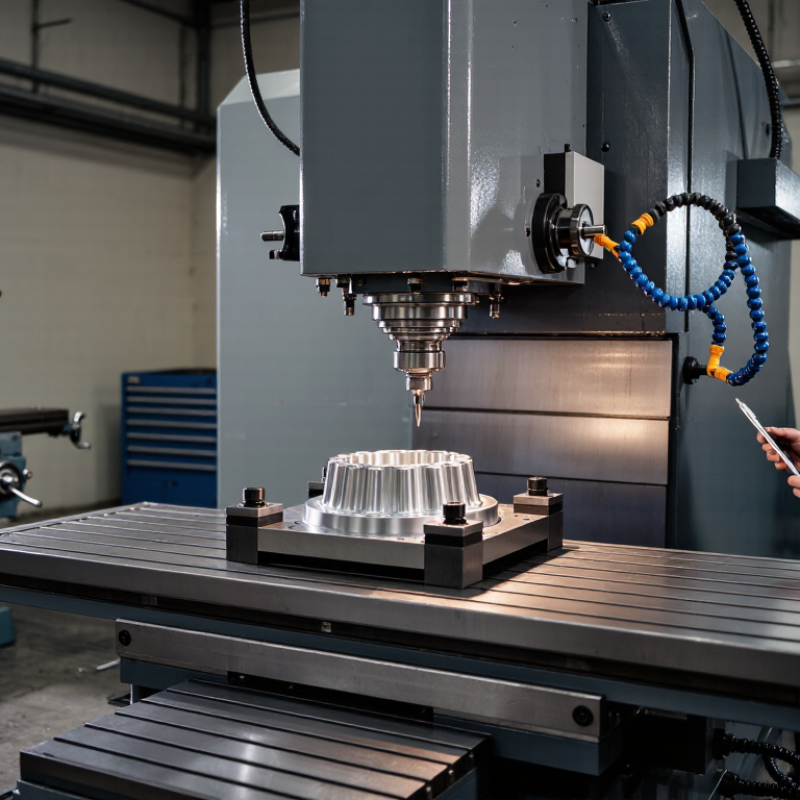
Choosing a CNC vertical milling machine starts with the workpiece, not the machine’s brochure. Record material, dimensions, weight, hardness, and batch size. A 200 × 120 × 50 mm aluminum block needs different cutting conditions from a 150 mm hardened-steel mold insert. Check the largest tool diameter, required spindle speed, and table load. Leave room for clamps and chip evacuation. Small details matter.
According to the 2023 U.S. Cutting Tool Consumption report from USCTI and AMT, American cutting-tool consumption was approximately 2.5 billion dollars. This figure reflects the scale of machining demand and the cost of choosing unsuitable tooling. Match the machine to actual cutting loads. For heavy steel removal, prioritize spindle torque and rigidity. For aluminum and small parts, higher speed and rapid tool changes may matter more. ISO 230-2 also provides methods for testing positioning accuracy and repeatability. Ask for measured results, not only rated specifications.
Define tolerance, surface finish, and inspection method before comparing machines. A ±0.01 mm requirement may require thermal control, stable fixturing, and better measurement equipment. It is easy to overestimate accuracy from a single test piece. I have seen plans ignore fixture access, then lose hours during setup. That mistake is expensive. Think again. A machine that fits the workpiece but cannot hold the process is not truly suitable.
How to Choose a CNC Vertical Milling Machine – Define the Workpieces and Machining Requirements
| Workpiece Type | Typical Material | Workpiece Size and Mass | Common Machining Operations | Typical Accuracy and Finish Needs | Useful Machine Requirements |
|---|---|---|---|---|---|
| Small precision brackets and plates | Aluminum alloys, mild steel | Up to about 300 × 200 × 100 mm; usually under 20 kg | Face milling, pocketing, drilling, tapping, contouring | General dimensions around ±0.05 mm; finer tolerances may require controlled setup and inspection | Compact work envelope, reliable tool changing, suitable spindle speed for aluminum, and a rigid fixture or vise setup |
| Steel machine components and housings | Carbon steel, alloy steel, cast iron | About 300–800 mm long; roughly 20–250 kg | Face milling, slotting, boring, drilling, tapping, heavy roughing | Commonly ±0.05–0.10 mm, depending on feature and process; stable finishing is important | Rigid column and table, adequate spindle torque at lower speeds, sufficient table load capacity, and effective coolant delivery |
| Multi-face prismatic parts | Aluminum, steel, stainless steel | Typically 200–600 mm across; often 10–150 kg | Face milling, drilling, tapping, pocketing, machining features on multiple sides | Feature-to-feature position and squareness may be more important than a single size tolerance | Consider a 4th-axis rotary table or indexing fixture, enough Z-axis clearance, and probing to reduce setup errors |
| Large plates, frames, and base components | Cast iron, steel, aluminum | About 800–1,500 mm long; may exceed 250 kg | Large-area face milling, long slots, drilling patterns, shallow contouring | Flatness and parallelism requirements should be specified separately from general dimensional tolerances | Long X-axis travel, a spacious table, verified load capacity, adequate floor space, and a plan for workholding and part loading |
| Thin-walled or lightweight components | Aluminum alloys, stainless steel, engineering plastics | Varies; often large relative to wall thickness | Light cuts, contouring, pocketing, drilling, finishing passes | Control of distortion, burrs, and surface finish is often a key requirement | Low-vibration machining, suitable high-speed spindle options, well-designed support fixtures, and adjustable cutting parameters |
| Hard-to-machine or heat-resistant parts | Stainless steel, titanium alloys, nickel-based alloys | Usually small to medium parts; mass depends on the component | Slotting, pocketing, drilling, profiling, controlled roughing and finishing | Consistency and tool life can be as important as final tolerance and surface finish | High rigidity, stable torque delivery, through-spindle coolant where appropriate, and sufficient tool capacity for planned operations |
Selection note: Confirm the largest workpiece dimensions, total setup mass, fixture height, required axis travel, and the tightest tolerances before comparing machines. The figures above are general planning ranges; actual requirements depend on part geometry, material condition, tooling, and process capability.
Spindle power matters during continuous cutting, especially in steel or other hard materials. Check torque at working speeds, not only maximum horsepower. High power can disappoint.
Not always. Small carbide cutters may need high RPM, while large face mills need lower speed and stronger torque. Match speed to cutter diameter, material, and finish requirements.
Bring a typical cutter and workpiece. Make a real cut and listen for vibration. The sound may reveal weaknesses hidden by specifications.
Confirm the spindle taper, holder type, tool-change capacity, tool weight, and cutting-load limits. Existing holders may not fit. A mismatch adds cost and setup time.
Look for clear tool offsets, alarm history, simulation, and protected program access. Operators should recover easily from tool-length errors. Fancy graphics are not enough.
Treat them as test results, not promises. Ask about repeatability, temperature, axis travel, and measurement conditions. Heat, fixtures, and long runs can change accuracy.
Tool measurement, probing, chip removal, and pallet exchange can reduce handling time. Choose features that match your actual work mix. Unused automation becomes expensive clutter.
Check maintenance access, network security, sensor compatibility, and operator training. Reliable data matters. I may overvalue advanced functions when simple consistency is more useful.
Choosing the right Cnc Vertical Milling Machine begins with clearly defining the workpieces, materials, dimensions, tolerances, and production volume involved. These requirements determine the necessary machine size, axis travel, and work envelope, ensuring that parts can be positioned and machined without limitations. It is also important to evaluate spindle power and speed according to the materials and cutting operations, while confirming compatibility with the required tooling and holders.
A practical selection should also include a review of the control system, positioning accuracy, repeatability, and available automation features. These functions can improve productivity, consistency, and ease of operation. Before making a final decision, assess installation conditions, maintenance access, operator safety features, training needs, and long-term operating costs. Considering purchase price, energy use, tooling, service, and downtime together will help identify a reliable machine that matches both current production needs and future expansion plans.
